Feed on
Posts
Comments

Trich Tools

Finger-Energy Transformational Tools

Want to know a secret about me?

I have energy coursing through my fingers — ALL THE TIME. It’s my secret superpower… though I don’t always view it in such a positive light.

Today’s photo introduces you to some new tools. Not my usual needles, horsehair, and thread, these tools help me to channel my finger-energy superpower in constructive directions.

See, I bite my nails. I pick at my cuticles. I pull at my eyebrows compulsively.

Over the years, I’ve sometimes thought myself weak in the face of these urges. Weak because I haven’t been able to stop the behaviors consistently for long periods of time.

But then, when I really look at it…

Sitting in meetings or lectures, I often glance around the room. Most people sit calmly (externally, of course; I have no idea what’s going on in their minds!). Their hands rest immobile in their laps or on the table. Perhaps a few hands are doodling.

I used to marvel at the stoic strength I imagined those still-handed people possessed. Why was I so weak that I couldn’t just keep my hands in my lap like everyone else?

It took me a while, but slowly it dawned on me that most other people weren’t exerting any will at all to keep their hands still.

Nor were they demonstrating any strength.

They simply didn’t have the same impulses coursing through their bodies as I did. As I do. The same energy coursing through their fingers.

Don’t get me wrong. They surely have other challenges of their own, but their hands… Their hands are still.

Mine are always in motion. I pick at every imperfection on my cuticles, and I pull on my eyebrows and eyelashes. Itches need scratching. Sleeves need straightening. The energy doesn’t rest.

For me, sacred needlework, stitching buddhas, is a way to channel that energy, to transform it into wisdom and beauty and inspiration.

The same fingers that pick at each other and pull out my eyebrows can wrap the most exquisite cords of silk. They find joy in making and are always willing to pull out stitches that aren’t quite right. And to stitch them again, and yet again if necessary.

I have hoped that this channeling of the finger energy into art would result in a cessation of my self-destructive picking and pulling.

Not only have I hoped, but I’ve engaged in every therapy and treatment form that’s ever shown any promise. And I’ve been successful, sometimes for months at a time. Once, even for a year.

But after a while, the energy returns without fail. It will not be quelled. The fingers start moving and picking and pulling again.

I’m still hoping.

But I’m not waiting around. In the meantime, I’m making beautiful things that bring me joy and that serve to inspire others. For that, I’m grateful.

I have come to understand that I may never subdue that pulsating finger-energy. And I may not control it very well either. But I can dance with it. I can honor it. I can see its gifts alongside its torment. It’s taken me a long time, a lifetime, to get here. And the acceptance is not constant. A lot of other people who suffer from these conditions are much more deeply tormented. Children who pick and pull are humiliated and ashamed.

This tormenting condition has a name. It’s called trichotillomania, which is actually no kind of mania at all.

It’s just the irresistible urge to pull out one’s own hair or, in my case, eyebrows and eyelashes. And, in my case, it’s connected with the compulsion to pick at any imperfection in my skin too, especially on my fingers.

The Trichotillomania Learning Center (TLC), founded by Christina Pearson in 1991, is the only organization dedicated to research and treatment of compulsive hair pulling and skin picking. There’s a wealth of information, resources, and concern there. And for the next two months, they’re sponsoring the Hands-Down-a-Thon, in which I’m participating and for which I’d like your support.

My personal commitment for the next two months is to wear gloves whenever I’m reading and writing at home (I’m wearing them now!) and to play with Crazy Aaron’s Thinking Putty (far superior to Silly Putty) when I’m reading and writing in public. While stopped in traffic, I’ll hold onto my stretchy, squishy, fiddly toy. These practices will impede me from using my precious finger energy to harm myself. You can see all my tools in the picture!

At the same time, I commit to publishing photos of my completed Samantabhadra thangka at the end of October. My finger energy will be channeled toward the creation of beauty and the inspiration of others. Including you!

To sponsor me in the Hands-Down-a-Thon and make a donation to the Trichotillomania Learning Center’s work, click the button below and go to my fundraising page. All funds go to the TLC, to support research and healing for hair pullers and skin pickers. Thank you so much!

By the way, do you have any energy demons in your life? Can you find a way in which those same energies are also your greatest strengths and allies?

  • Share/Bookmark

Stitch Eat, Pray, Love

I wasn’t supposed to like the book.

I happened to catch Elizabeth Gilbert on Oprah at my mother’s house during one of my visits to California from Italy. I thought she was pretentious. I thought she was superficial. I thought she was naive.

I thought she didn’t know a thing about life in India… or in Italy… both of which I had lived in for several years without a book to my name while she was making millions after only four months in each place. (Okay, I was snarky.)

But really, my hackles come up when I think people are stereotyping these countries I’ve lived in. Life in India is not all **HOLY** and Italy’s not all about sex and food… well, okay, maybe it is all about FOOD.

But, anyway, it was mostly the simplistic holy India stuff I objected to.

But I read the book.

And though I really wanted not to like it, I LOVED it.

Ms. Gilbert was intelligent, and thoughtful, and introspective in genuine ways. She looked at her life and understood some things. I wanted to read it again as soon as I’d finished.

Now the movie’s out. With Julia Roberts in Liz Gilbert’s role (and looking uncannily like her in some scenes).

The movie’s not as good as the book. It’s more superficial. It’s an external view, as movies are, while Gilbert’s journey was mostly internal. It is beautiful though, and a pleasant way to spend two hours. The color, beauty, and sensuousness are appealing for people like me — and probably you, if you’re reading this — who revel in color and texture.

The scenes of Italy and India made me miss both my homes. I realized that I miss hearing the Italian language spoken almost as much as I miss Tibetan. And a good pizza…

And INDIA! Those dirty chaotic street scenes still tug at something deep in me. Strangely, though, my Indian experience was more like her Italy in many ways.  And my Italy was nothing like hers.

The scenes that touched me most deeply, though, were two that speak to feelings present in me now. Back in California. Making a new home.

Wise Richard from Texas counsels Liz who misses her boyfriend.

“I love him,” she pleads. “I miss him.”

“So miss him,” Richard responds. “Send him light and love every time you think of him and drop it.” (Okay, the light and love stuff is a little corny, but you get the point. Send him your best intentions. Wish him well. Metta. Lovingkindness.)

Later, Liz holds her ex-husband in her thoughts. She holds him with love and release. And feels his pain.

“I really did love you,” she tells him. (And I know my own husband would tell me the same.)

“I know,” he replies (and I hear myself). “But I still love you. I miss you.

“So love me,” says Liz in her wise Richard voice. “Miss me. … and then drop it.”

Feel the feelings. Don’t pick up the story. That’s what being awake’s about.

It won’t last forever. Nothing does.

Oh, and believe in love again. Bali comes next ;-)

  • Share/Bookmark

Sun Valley Spiritual Film Festival 2010I’m so excited to be the featured artist at the Sun Valley Spiritual Film Festival in September.

First of all, Sun Valley must be beautiful. The man who’ll be handling my artwork said I should be prepared to fall in love and make the inevitable decision to move there. It’s that intoxicating! We’ll see. I’m sure it will be nice.

Five of my pieces will be displayed in the Sun Valley Opera House, the main venue for the film screenings. They’ll probably flank the stage and be illuminated for three days by the grace of dozens of films that explore spiritual traditions from around the world and cherish the human spirit.

There will be

Of the 30 or so films of varying lengths and varying formats, I’m especially eager to see Brilliant Moon: Glimpses of Dilgo Khyentse Rinpoche. I never met that extraordinary mountain of a man, but my heart melts open every time I see a photo of him or hear his name. I already know I’ll be in tears throughout the film.

If you’re anywhere near Sun Valley — or want to come and risk falling in love with the place along with me — please join me and a whole bunch of brilliant filmmakers and  spiritual journeyers from September 17 to 19.

Find me and introduce yourself. I would love to meet you.

  • Share/Bookmark

I don’t  usually close the door when I sit down to meditate in the morning. The house is empty except for the cats. A low altar sits in a corner of my bedroom. Facing the altar are two flat green cushions and a green shawl to cover my knees. (I’m rather obsessive about color coordination. It helps in my work.)

My meditation corner feels good to me, inviting. That’s important. We find so many reasons to avoid the simple pleasure of sitting down with ourselves. The more inviting and comfortable my space feels, the more likely I am to use it.

I light incense. I prefer an earthy Tibetan incense but don’t have any, so I accept the flowery perfume of an Indian incense or of the handmade incense I picked up at my local farmers’ market last week.

I sit down. Fidget a bit until my legs and back are comfortable. Adjust my clothing, the shawl. And rest my attention on my breath.

Then comes Sushi.

Now, Sushi (Sushila for long) is the younger and more rambunctious of my two cats. The older one, Crusca, sits with me often while I meditate. She melts in my lap, like a cushion on my legs, her breathing almost synchronizing with my own. No problem.

Sushi, however, is a different animal altogether! Sitting still is not in her repertoire… And here she is.

Walking across my knees, sitting down, standing up, turning around. Nudging my wrists and fingers, seeking a reaction (stroking or scratching her just results in more nudging). Stretching her body up to touch my chin with her wet nose.

I practice.

Present. Nonreactive. Letting her be a metaphor for my monkey mind (maybe I should call it my rambunctious-cat mind or my Sushi mind…) I let her do what she does, and I sit. Still amidst movement.

Gradually, receiving no reaction to her promptings, Sushi settles down. She curls up on my lap and rests.

All calm, right?

Fat chance!

Without her movements to predominate, my thoughts run rampant. Itches arise and move about.

Again, I sit. Nonreactive. Calm.

Let the thoughts run as they will. Don’t pick them up. Don’t follow them. Without preference. They are simply thoughts, the natural, spontaneous activity of the mind. How fascinating. Itches just itch. Until they don’t. Let go. Let be. Calm.

Then what?

My mind is relatively calm, my breath soft. Sushi is curled on my lap, unperturbed.

I move my hand to pet her (who knows why!)

Uh oh! I’ve reached out and activated her.

And the cycle starts again.

Isn’t meditation fascinating?!

  • Share/Bookmark

Thangka Rolled Up in the Traditional Way

Thangka Rolled Up in the Traditional Way

Today’s post comes in response to a reader. (Thanks for the push! It was time to get writing again.)

So you bought a thangka or had one commissioned while you were on pilgrimage in India, trekking in Nepal, or otherwise traveling the world.

Maybe you’ve commissioned a thangka from me or from a Tibetan or western thangka painter in your own town.

It’s been hanging on your wall, above your altar, in your living room, blessing and inspiring you for a while now. Then one day the moment arrives –

  • it’s moving day or
  • you’ve agreed to lend the thangka to a dharma center for a teaching event or
  • you have to store it while your house is being painted…

How do you roll up the thangka to move or store it?

Well, do you want the traditional answer or the conservator’s advice?

I’ll give you both. ;-)

Ann Shaftel, art conservator specialized in thangka conservation has been working with Tibetan and Bhutanese communities to improve their conservation practices. Just so you know — traditional is not always best.

Improper handling also causes great damage to these objects. The thangka form was devised to facilitate easy transportation; nevertheless, rolling and unrolling a painting over the centuries causes damage to the support, ground and paint layers.

Ann Shaftel, Journal of the American Institute for Conservation

Still, thangkas are made for rolling up. Some even say that the word thangka, in Tibetan, means “something that rolls up.” (It’s also said to refer to a flat surface, like a field… or a canvas.)

Whatever the origin, a thangka, today, is a sacred figurative scroll, sometimes painted on canvas, other times stitched in silk. However it’s made, it’s usually framed in a flexible brocade border and can roll up. (For the alternative methods of framing your painted thangka, see my previous post, Who Can Frame my Thangka in Brocade?)

In Tibet, thangkas were carried from place to place and brought in and out of storage frequently. The entire composite object was designed with all phases of a thangka’s life — display, storage, transport — in mind. It was a very practical system… but it was not designed by art conservators and may not be the very best way to protect your treasured art.

In my post, How to Hang a Thangka , I describe the parts of a thangka, including the image, brocade borders, upper and lower wooden supports, silk drape, and straps for hanging and tying. Ann Shaftel generously provides the illustration below.

Parts of a Thangka, excerpted from Intent, In Tents and Intense © 1993 by Ann Shaftel

Parts of a Thangka, excerpted from "Intent, In Tents and Intense" © 1993 by Ann Shaftel

If your thangka is assembled in this traditional way (and you don’t have a flat storage option available), you will probably want to follow the traditional method of rolling it. After all, it’s elegantly designed just for that.

In this case, you will roll the thangka with the image on the inside, covered by the silk drape. The process requires two people. I don’t have step-by-step photos to show you yet but will add some later.

For now, here are the instructions:

  1. Release the silk drape from its gather at the top of the thangka. Let it fall down over the image.
  2. Take the thangka down from the wall without bunching or crunching it.
  3. One person holds the upper wooden bar at waist height.
  4. The second person, the roller, takes the lower wooden dowel at a similar height and stands at a distance so that the thangka is pulled taut and horizontal, with the image facing upward covered by the silk drape.
  5. The person holding the top bar stands firm, providing an anchor to keep the thangka consistently taut while the second person rolls it up.
  6. The person at the lower end of the thangka smooths the silk drape over the thangka, making it as unwrinkled as possible and gathering it inward so that it covers the entire thangka but does not protrude at the sides.
  7. Pulling taut, start to roll the thangka up from the bottom, around the dowel. The silk drape will protect the surface of the painting inside, and the cotton backing will show on the outside of the roll.
  8. As you roll keep your hands to the edges so that any pressure you apply is on the brocade border and not on the image itself. This is especially important for painted thangkas, as the canvas can easily crease and the paint crack if pressure is applied to it.
  9. When the thangka is completely rolled up — the roller had reached the person holding the upper bar — each person takes one end of the rolled thangka and ties the straps around it, to secure the roll. Again, it’s very important that the straps be tied around the brocade borders and NOT around the painting itself. The straps are normally attached to the upper wooden bar at a point where they would crunch the painting if wrapped straight around. Therefore, it is necessary to draw them toward the ends of the roll first, looping them over your thumb and then wrap them around the roll so that they bind it near the ends, pressing on the brocade rather than the painting.
  10. If you will be carrying the rolled-up thangka yourself or keeping it in a safe, undisturbed place, you can keep it like this. If you think it may get bumped or disturbed, you may want to place the roll  in a drawing tube for protection. Telescoping plastic drawing tubes with carrying straps can be purchased at any art supply store, or you can use a cardboard mailing tube if you find one wide enough to hold your thangka.

From a conservator’s point of view, it’s best to store any artwork flat if you have the space.

Protected flat storage carries the least risk of damage. But most of us (and even many museums) don’t have adequate flat storage space to keep or move our thangkas that way.

The second best way of storing or transporting textiles and paintings is to roll them facing outward (the opposite of the way the traditional thangka system is designed) around a wide tube.

Rolling outward allows the surface to remain flatter rather than collapsing in on itself. If your thangka is unframed, you can roll it around the widest packing tube you can find. Make sure the tube is as long or longer than the width of your thangka, so that the edges of the thangka do not extend beyond the edges of the tube. Place a muslin cloth or acid-free paper between the thangka and the tube and roll facing out. Make sure your muslin or paper is long enough to cover the outside of the thangka when rolling is complete.

So, as is often the case, we’re presented with a traditional method and some contemporary learning.

What do I do with my own thangkas?

When they’re framed in the traditional way (and when people commission me to create traditional thangkas), I roll them in the traditional way, facing inward. The composite object of the thangka is an elegant system that I respect and comply with.

On the other hand, when I make my contemporary thangkas, I do not use the traditional brocade border and mounting system. I design them more like art quilts (with a fabric tunnel at the back for inserting a bar but with no rigid bars integrated into the piece) and roll them outward around a wide tube for transport and storage.

Best of both worlds, and adapting to circumstances. It’s the best we can do!

In general, of course, I keep my thangkas hanging on the wall as much as possible, where they can bless and inspire me and whoever passes by. Thanks for passing by!

  • Share/Bookmark
Threads of Awakening, Weekly Wake-Up 003

Threads of Awakening, Weekly Wake-Up 003

Do you make a big deal of things?

I know I do.

Much more often than I’d like to, I see my problems as real and important and urgent.

It can help to shift your attention off the foreground and onto the background in those moments. It can help to reflect on context.

How fleeting this moment is. How small a part of the ongoing magnificence our immediate challenge is.

A central aim of Buddhist practice is the reduction of self-concern. This does not mean that you should neglect your well-being or treat yourself with anything but the utmost kindness and respect. Quite the contrary! YOU are the only vehicle you’ve got for doing anything of benefit in this life. So be good to yourself!

But put your self-concern in context. See its disproportionate scale. Watch how it distorts your perspective. Challenge it to reveal itself for what it is.

Try this:

Practice moving in and out of whatever’s going on right now, in this moment. Remember, “the key principle of meditation is to return to what’s already there and rest.” Like those tiny creatures at war in the flea’s eyebrow, BE in YOUR war. Experience its sensations.

Then, for a few moments, expand the field of your awareness. Notice or imagine the ground you’re standing on, the expanse of “eyebrow” around you, your bodily sensations. Expand further and imagine the flea-face that eyebrow sits on — the sounds, smells, and visual stimuli of your environment.

Feel the contours of that context and notice how it moves and changes. Expand to the whole body that flea-face rests on — to your community, your country, or the planet — and imagine it interacting with countless others just like it… and countless others unlike it.

Then return to your challenge.

Does it feel different? All its sensations and motives are still there, but have you shifted in relation to them? What shifted?

Notice.

And then expand out again.

And return once more.

Rest.

*******

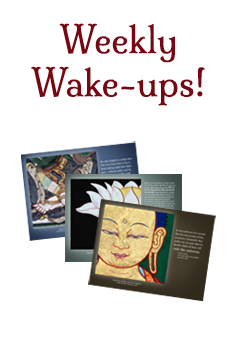
By the way, the picture and quote above make up this week’s Weekly Wake-up. Every week I send messages like this to my mailing list. If you’d like to receive them, just fill your name and email address in the form to the right.

And also by the way, the Buddha’s face on this week’s Wake-Up (a detail from my 1997 thangka Buddha Shakyamuni and the Six Supports) is now also available on a real US postage stamp. The customized stamps do cost more than normal postage, but they’ll also give your letters a unique impact.

  • Share/Bookmark

Wake Up Weekly

Threads of Awakening Weekly Wake-UpsHi everyone! Did you notice the new box to your right? I’ve got an offer for you.

Ever want to get a closer look at the layers of silk that make up a fabric thangka? Want to search for the stitches? Or just want to ooh and ahh?

Starting next Monday, you’ll get a close-up look at one of my silk thangkas — right in your mailbox every week. You’ll even be able to save the images on your desktop if you want to keep on looking.

Now, the purpose of all these images is to inspire. To still. To get off automatic and to wake up. To become truly present to what is (rather than to what we wish or fear or believe to be).

SO along with those images, you’ll also get a quote. (Not from me, I wouldn’t know what to say ;-) ) A quote from some wise teacher or poet, or from someone who just said something so right-on that it can bring you back to clarity every time you read it. A quote to remind you of what you already know.  A quote to inspire and to wake up.

That’s why this gift is called the Weekly Wake-up.  Its purpose is to start your week fresh, clear, awake, inspired.

Just type your name and email address in the form to the right and hit the “Wake up my Weeks” button. Then click to say ‘yes’ when the confirmation message arrives.

Next Monday, you’ll get your first Wake-up.

If it inspires you, send me an email or leave a comment below.

Wishing you much joy,

Leslie

  • Share/Bookmark

This week’s eZine article from Christine Kane is right in line with my own current practice. Use the gentle power of ritual to set the stage for your day.

Rather than letting the winds of chance toss you out of bed and into the world — where you can then react, react, react — why not set the table for your day, invite it in, and regale it with the feast you’re serving?

I’ve been deepening my commitment to what I call my “morning practices” for months. Today, inspired by Christine’s article (which you’ll find quoted below), I fine-tuned in into a ritual.

Even in the course of my ritual, I get easily distracted by things I see that need doing (Gotta change the cat litter. Oh, I got those little cushions to put on the bottom of the chair legs! What’s that spot? Better clean it up…) Having a ritual gives me an anchor to come back to when I get distracted. Read my own morning ritual after the article below. And share your own in the comments!

Here’s Christine’s article:

How to Create a Powerful Morning Ritual

by Christine Kane

It is said that your habits create your destiny.

I’d add that your habits also create your confidence, courage and even your creativity!

In other words, your daily choices, routines, and seemingly insignificant moments make all the difference in your results.

One of the best ways to generate great results is to create a morning ritual. A powerful morning ritual sets the tone for your entire day – and your entire year!

A ritual is personal. A ritual is creative. (Not reactive!) A ritual is what gets YOU on track to create your best day. (And subsequently, your best life!) It can be as simple as a 15-minute routine, or as intense as long-distance running. The important thing is that it becomes a HABIT.

My morning ritual combines a mixture of physical, mental and heart-centered activities to engage each of these human power centers!

Here are some ideas to help you create your own powerful morning ritual.

Hydrate First

Many Eastern health practitioners recommend chugging down at least a half-liter of filtered room-temperature water first thing. (Yes, before your coffee!)

Upon waking, your body has spent hours without hydration. Drinking pure water at this time triggers a series of physiological functions that keep your body super healthy. Some report that this one practice can actually heal many diseases. (I’m not a scientist – but I can attest to the amazing results!)

Get Moving

Exercise is called “The Number One Form of Preventive Medicine.”

It is also a prescription for happiness and a cure for depression! Getting exercise first thing sets your day off right. You can do a simple stretching routine, yoga or an all-out heart-pounding hour at the gym. Pick something do-able and do it.

Meditate

Many people don’t meditate because they find it intimidating. I say, start with just 5 minutes. Meditation connects you to your center, and to the deep silence that surpasses any drama that might be happening in the world of your personality. Don’t worry about doing it right. Just allow yourself the time to BE.

Set Intention

“Intention rules the earth,” says Oprah Winfrey.

It’s true! Your intention is a powerful force to engage.

Remembering your intention puts you back on track. You become focused again.

Reflect for a moment on your Word of the Year. Read a goal you’ve written down for yourself. Remind yourself of a financial dream. (If you’re one of my new students in Uplevel Your Business, read the intention you wrote down on the first day of the program!)

You don’t have to know the HOW. You just need to set the intention so your inner GPS can stay on target!

Be Grateful

Before I get out of bed, I silently create a morning gratitude list. When I begin my day remembering my “gratitudes,” (instead of my “anxieties”) my heart fills with extreme joy and deep awareness. I then bring that energy into everything I do – and to everyone with whom I connect.

Use a Netty Pot

(This one’s a little weird!)

For years, my acupuncturist told my husband and I to use a Netty Pot. We laughed at him. Then, in the face of acute sinus problems, my husband tried it and became a convert. He converted me.

A Netty Pot uses warm water and a special salt to cleanse your sinuses and clear your breathing. Google it, and let the idea sit with you for a while. (You might be a convert too!)

Eat Creative

Your choice of breakfast foods can set up your success with other meals as well. Start your day off in the healthiest way possible for you – and make it a ritual, not a chore.

Be Prepared: Create a Not-to-Do List

Everyone needs a “Not To Do” morning list.

Suggestions here include anything that brings up a “reactive” state: Turning on the local news. Checking email. Answering texts. Answering the phone.

Let these things wait until AFTER your ritual has been completed!

Your Assignment:

After reading this article, don’t just think, “Wow. Those are some good ideas. I should try one or two.”

Instead, deliberately create your morning ritual now. Take about 20 minutes to think about and write down what your ritual will be each morning. Start simple at first. Choose one or two items from this menu. Or come up with your own. Write out your Ritual in detail.

Begin first thing tomorrow morning, and let your habits create YOUR destiny starting now!

Performer, songwriter, and creativity consultant Christine Kane publishes her ‘LiveCreative’ weekly ezine with more than 11,000 subscribers. If you want to be the artist of your life and create authentic and lasting success, you can sign up for a FRE*E subscription to LiveCreative at www.christinekane.com.

Hi! This is Leslie again. Here’s my own morning ritual:

  • WHILE STILL IN BED,
    • Touch in to GRATITUDE – Read the five things I’m grateful for that I wrote down the night before. If I didn’t write at night, do it now.
    • Attend to my INTENTION- Read phrases I’ve generated in recent work with my coaches. Reflect on my word for the year, DECIDE.
  • GET UP. Go to the bathroom. Brush teeth. Wash face. Drink a glass of water.
  • Light incense and walk it around the house, blessing and welcoming every corner of my environment, every direction of my world. Open the front door, ring the windchimes.
  • Meditate for 15 minutes. (In other periods, it’s longer. Right now, I let 15 minutes be enough. Consistency is more important than quantity.)
  • Shower (unless I’m going to the gym later).
  • Make coffee or juice. Drink.
  • Now get on with the day!

WHAT’s YOUR RITUAL? (Of course, if you have small children, you’ll have special challenges to protecting your ritual space. Have you found creative ways to approach the challenge?)

  • Share/Bookmark

Ruth Davis Sparks the Heart

Ruth Davis Sparks the Heart

I consider myself very lucky to have met Ruth Davis two and a half months ago at the amazing Wide Awake Weekend at the Biltmore Estate in Asheville, North Carolina. We had already met — virtually — over the course of Christine Kane’s Uplevel Your Business program. At the beginning of that program, I’d been intrigued by photos of a community prayer flag project Ruth had initiated in Arizona. Community, creativity, cloth, open air, good wishes, and an allusion to Tibetan culture (even if unintended). This was a woman after my own heart!

We interacted on the course forum and I enjoyed hearing Ruth’s comments in teleconferences. When we finally met in person in the Biltmore bathroom on the first day of the Wide Awake event, I suggested impulsively that I might visit Ruth in Phoenix sometime. (There’s some possibility I’ll be in the area…)

Her response caught me off guard and made me treasure her even more:

“Wait,” she said, “We don’t even know if we like each other yet.” She said these words with such clarity, warmth, love, and honesty, I was stunned… positively. THIS is an HONEST woman, I thought. I can count on her.

As the days wore on, it became clear that we did, in fact, like each other. Ruth is funny (though she doesn’t think she is), insightful, incisive, and encouraging. Several times over the course of the week, she pulled me back from my mental wanderings and set me clearly back on my feet, back on purpose, in awe of my blessings. I recommend her workshops, retreats, coaching — any way you can connect to her (even computer consulting through her Mac to School services) — to anyone who wants the assistance of an honest, courageous, funny, encouraging, vision-expanding mirror.

Oh, and I’m honored that Ruth chose to interview me for her new Passionate People Project. Check it out (below and on her site)!


This Month’s Passionate Person is

Leslie Rinchen-Wongmo

Leslie Rinchen-Wongmo is a contemporary American textile artist and carrier of a sacred Tibetan artistic tradition. Her work has been exhibited internationally and is featured in the documentary film, Creating Buddhas: the Making and Meaning of Fabric Thangkas. After living many years abroad in India and Italy, she’s currently re-nesting in her native California. To learn more about Leslie and Tibetan fabric art, visit www.silkthangka.com

I asked Leslie to share her thoughts about her work, her process, how she has created a life filled with passion and purpose.

What is your life’s passion and purpose?

To examine my own attitudes and relationship with the world. To grow, to live a life I create rather than fitting myself into a pre-designed slot, to make beautiful things with a positive, transformative message, to touch other people in meaningful ways with my creations.

To live ever more in accord with how things are rather than with how I wish they were or how I’m afraid they are. And to smile. Smiling is always useful and probably what I’m best at.

How did you discover these passions?

I always liked making things pretty. And I think I was born with an attitude of not accepting circumstances as they’re handed to me and of choosing roads a bit less traveled.

Though plagued by fears, I’ve always been an adventurer and an idealist. And I’ve always liked hanging out with people who think a bit differently. I was in theater in high school, went to a college where questioning the status quo was paramount and beauty was everywhere. Later, I left the job my degrees had prepared me for to travel and somehow never could go back.

How did you discover that you loved specifically creating beautiful things with a positive, transformative message?

I traveled to India and lived with the Tibetans exiled there. At first I was volunteering in development projects, but it soon became clear that I loved everything about my life there except the “job.”

When I first saw sacred Buddhist images being made from pieces of silk, I felt a surge of energy, interest, and right-ness. A fit. I love fabric, texture, colors… and my life is about transformation and growth. This art unified these two threads in a way I’d never imagined possible.

I was not a vajrayana practitioner at the time (and barely am now), but I intuited the power of the practice, its real and potential benefit to people. While I didn’t feel confident I could become a buddha, I did know I could stitch. It was my way of participating in a profound spiritual practice, and my way of expressing the beauty of that practice to others.

What obstacles did you encounter as you shifted your heart’s desires into the work that sustains you?

I have always been very fortunate. I don’t think I encountered any obstacles early on. I followed what felt natural to me. I was willing (deeply content, actually) to live simply in India and to learn and make this art.

I had already left the job for which my degrees had prepared me, to pursue an adventure of traveling afar and living in different contexts. I simply (and perhaps foolishly) followed what felt good and right to me. I say foolishly because, as my good fortune continued, I managed to keep following my path even if it wasn’t financially viable — or perhaps I should say without finding ways to make it financially viable. Though I continue to enjoy good fortune, my thoughts about being financially dependent on others cause me some distress.

What has been your biggest obstacle?

Probably my own mind wondering whether it’s really “okay” to be doing what I’m doing. I have few role models.

How did you manifest your passions into a life that supports you financially, spiritually and emotionally?

That’s evolving. And shifting with context. I have realized that, though I love autonomy and hours of solitary work, I also crave human interaction. I thrive in connection with others. I’m motivated by seeing the inspirational quality of my work reflected in viewers’ eyes or by seeing a student’s satisfaction at creating beauty of their own. And I love laughing with people.

In India, my work day was naturally interspersed with abundant social contact. People dropped by for tea. I was greeted enthusiastically from doors that lined the path on my way to market.

Life in the west is different. And I need to deliberately create opportunities for interaction. Not realizing that deliberate action was required or how to go about it led to dissatisfying periods of isolation and, consequently, less joy in creating my artwork as well.

I began teaching last year to address this personal need for a human connection, and to offer what I can to others. Teaching English as well as fabric thangka making… and soon I may add Italian! This interactive activity has brought new energy to my work.

How do you maintain your excitement and enthusiasm for living from your heart?

I don’t maintain it; it maintains me. It’s the only way I know how to live. If I try to live otherwise, I’m miserable, and I know that can’t be right.

I also continually look for ways to make my work my own while honoring the sacred tradition from which it comes. Sometimes that feels like a balancing act, but usually it’s very natural.

I treasure the Tibetan tradition that gave me the techniques and imagery I work with. At the same time, I’m not a Tibetan. I live in the western world and in contemporary times. So my technique and imagery evolves, and new teaching methods need to be invented. My students are all over the world — in Europe, the US, Asia, and the South Pacific. We can’t all sit around a table together to stitch. I’m pressed to explore what’s available in our contemporary world and to invent new ways of transmitting an ancient tradition that was imparted to me in more traditional ways.

How do you measure your successes?

By joy. If I’m happy, I’m successful. And if I open some new possibility or vision for someone else, even just a small glimpse, then I’ve done what I’m here for.

What inspirations can you offer people who are seeking to manifest their passions into a life lived on purpose?

Well, many may say that they can’t do what I do because their circumstances are more limiting, and that may be true. But our circumstances are rarely (never?) what we think they are and will usually find a way to adapt to our choices.

Step out onto new ground and it will give a little to receive your step.

In Buddhism, we are encouraged to reflect on the great value of our precious human life. I’ll venture to say that everyone reading this is more fortunate than they realize and has more possibilities available to them than they have let themselves imagine. Look. Imagine.

To learn more about Leslie and Tibetan fabric art, visit www.silkthangka.com

* * * * * * * * * * * * * * * * * * * * *

If you do what you love and love what you do

and would like to be featured in the Passionate People Project

send Ruth an email

with a little information about yourself and a link to your website.

Join the Spark the Heart community by entering your info in the box on her site.

  • Share/Bookmark

Happy 2010!

34831737

Full moon bids farewell to 2009

Happy New Year! I’m so excited to be beginning 2010. The word I’ve chosen as my companion this year is “Decide,” and the first thing I’ve decided is to live this year with my heart open and my dreams out front. What about you?

As the year opens, I’m getting ready to introduce several new ways of sharing my work with you. In a few weeks, the Threads of Awakening Weekly Wake-ups will be available. I’ll send you an invitation as soon as they’re ready. Those of you who choose to receive them will be sent some inspiring eye-candy and heart/mind-food each Monday. Detail photos so close you can see the stitches, accompanied by quotes from some of the wisest, most insightful thinkers of our time — and past times.

My fabric thangka e-lesson program is growing into the Stitching Buddhas Virtual Apprentice Program. Exploiting the opportunities provided by new technologies, I’ll try to bring a live atelier or workshop experience into our online process.

Enhanced prints of Tara, the Buddhas, and Guru Rinpoche and are already available at my Fine Art America shop. Soon, you’ll be able to send the blessings of these images on real postage stamps.

These are just a few of the developments I’m working on — the ones that are visible to me now. I know from experience, though, that most of what’s in store this year is not yet visible.

I’m looking forward to watching things evolve in the context of my decisions to live open and to keep on sharing the beauty and inspiration I’ve been so fortunate to receive from the Tibetans and elsewhere. Thank you for being in my world. Happy 2010!

  • Share/Bookmark

Older Posts »

Related Posts Widget for Blogs by LinkWithin